Introduction
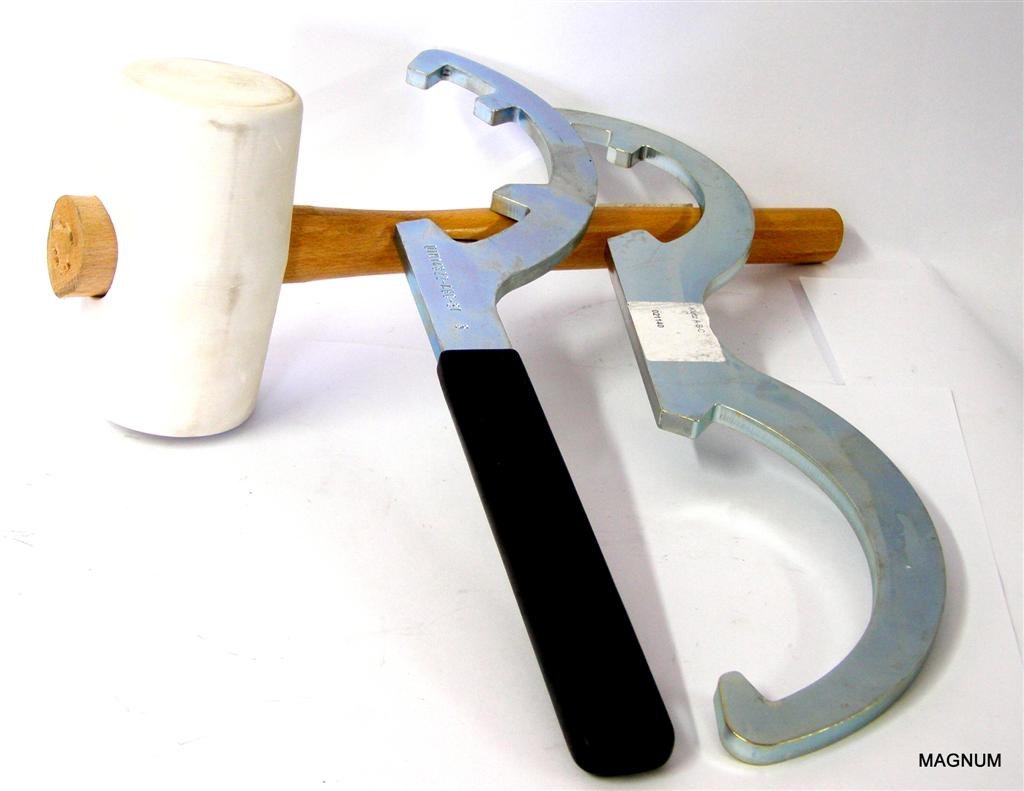
Operating a Spitzer SF/SK silo trailer during pneumatic discharge involves more than just the vehicle and its pipework — it also calls for a small set of hand tools without which day-to-day work becomes needlessly difficult. Two of these are indispensable in any Storz-system application: a rubber mallet for tapping the tank and a Storz coupling wrench. They may seem minor accessories, but their quality directly affects the efficiency and safety of bulk material discharge.
During pneumatic conveying of PE/PP granulate or other bulk materials, product can stick to the silo walls or settle on the cone. A gentle tap with a rubber mallet encourages the material to flow without any risk of damaging the tank shell — the rubber neither dents nor scratches the plate. The Storz coupling wrench, meanwhile, allows couplings to be engaged and released securely even after they have tightened under pressure. For any fleet of Spitzer SF/SK silo trailers, both tools are standard cab equipment and, as consumable items, need periodic replacement.
Choosing the right tool matters beyond mere convenience. Using an ordinary hard-faced hammer to tap a silo risks denting or puncturing the shell, which can lead to a costly tank repair further down the line. A mallet with a soft white natural-rubber head transfers the impact energy without endangering the plate. The same logic applies to the Storz wrench: improvised tools or ill-fitting spanners can damage the coupling lugs or cut the seal, causing leaks. A wrench designed to the Storz geometry allows couplings to be released and re-engaged cleanly and without damage, even when they are firmly locked after pressurised service.
Specifications and Materials
Rubber Silo Mallet
| Parameter | Value |
|---|---|
| Head material | White natural rubber |
| Handle | Wood |
| Head weight (without handle) | 750 g |
| Application | Tapping silo trailer tank |
White natural rubber is soft enough not to damage the silo shell yet resilient and durable. The absence of hard edges and its resistance to chipping mean the mallet leaves no marks or debris on the tank.
Storz Coupling Wrenches
| Parameter | Value |
|---|---|
| Material | High-tensile galvanised steel |
| Compatibility | Universal — sizes A, B, C |
| Classic version | Double-ended |
| Single-ended version | Insulated handle (soft anti-static rubber) |
High-tensile galvanised steel ensures durability and corrosion resistance under heavy field use. The universal sizing (A, B, C) means a single tool covers the majority of Storz connections found on silo trailers.
Sizes and Types
Storz coupling wrenches fit all sizes A, B, and C — there is no need to select by individual coupling size. Two design variants are available:
- Classic double-ended — a workhorse wrench for operating couplings from both sides.
- Single-ended with insulated handle — fitted with a soft anti-static rubber grip for added comfort and reduced electrostatic charge build-up.
The rubber mallet is produced in a single version — a white natural-rubber head (750 g without handle) mounted on a wooden handle.
Compatibility with Spitzer Silo Trailers (SF/SK)
Both tools are universal and require no matching to a specific model series or year of manufacture. The wrenches fit all Storz coupling sizes (A, B, C) found on Spitzer SF/SK discharge systems, and the rubber mallet is suitable for tapping the silos of these vehicles. They are the standard items to keep in the locker of every trailer equipped with a Storz system.
Common Issues
In everyday operation, the most frequent problems encountered are:
- Mallet head wear — intensive use gradually compresses or deforms the rubber; a badly worn head should be replaced before it risks transmitting harder impacts to the tank shell.
- Handle loosening or cracking — the joint between head and handle is subject to natural fatigue and should be checked regularly.
- Corrosion after zinc coating damage — abrasion of the galvanised layer can lead to surface rust; even so, the high-tensile steel retains its function.
- Handle insulation wear — on the single-ended version with soft anti-static rubber grip, worn insulation reduces working comfort.
We recommend periodic inspection of both tools and prompt replacement of worn components — a modest outlay that pays for itself in discharge efficiency and safe handling.
In fleet operation, a good habit is to equip each silo trailer with a standard Storz tool set: one universal wrench (classic double-ended or single-ended with insulated handle, depending on driver preference) and a rubber silo mallet. This eliminates situations where a driver in the field improvises with an unsuitable tool and risks damaging a coupling or the tank shell. For fleets operating in environments with elevated electrostatic risk — such as PE/PP granulate transport — the insulated-handle wrench is worth specifying as standard fitment.
Availability and Delivery
Rubber mallets and Storz coupling wrenches are held in stock at our facility in Chorula near Opole. We dispatch by courier throughout Poland and to the DACH region (Germany, Austria, Switzerland). Our location four kilometres from the A4 motorway and approximately 180 km from the German border means we can serve service customers on both sides quickly.
To order a mallet or select a wrench version (classic double-ended or single-ended with insulated handle), ask for a quote . State the type and quantity — we will confirm availability and prepare an offer.
Related Categories
See the full spare parts catalogue and related categories:
- Storz System — couplings, adapters, caps, and reducers.
- Storz Safety Clamps — classic protection for Storz connections.
- Storz Reducer Safety Clamps — reinforced version with metal lugs.
- Pneumatic Hoses — compressor and transport hoses.
Comprehensive silo trailer service and parts sourcing: magnumchorula.pl/en/service/ . Industry expertise and background: pasternak.me .
See also: This category in the full PHS Magnum network catalogue (all brands) →
Author: Aleksy Pasternak — Managing Partner PHS Magnum, 20 years in the industry, ISO 9001:2015 internal auditor (DEKRA).